
An Intuitive Guide To Risk, Returns And Trade-Sizing
In this article we explore the relationship between trade-size and its impact on investment returns and risks. In doing so, we’ll arrive at an intuitive understanding of two common metrics: volatility, a measure of risk, and its partner the Sharpe Ratio, which gauges returns relative to risk. We finish with a look at how trade size affects the ability of an investor to stay ‘in-the-game’, when faced with a sequential series of disasters.
As visualisation aids intuition, we’ve created a series of graphs based on back-testing typical investment strategies used by private investors. One strategy targets stocks with share price momentum, while the other targets value growth stocks. These strategies are encoded in the Example Investment System provided with RuleTrader, which we back-tested over a 10 year period from 2015 – 2024. Using RuleTrader’s automated test capability, we ran the test 19 times, while varying the trade-size from 2% to 20% of capital, implying a target of 50 to 5 positions at any one time.
Good Positions Are Hard To Find
One of the tenets of modern portfolio theory is that diversified holdings reduce risk. Ideally we’d hold investments across companies, sectors and geographies that have minimal correlation. In practice it’s not so easy for private investors focused on the UK stock market to find enough good opportunities that are truly uncorrelated.
This is graphically illustrated by Chart 1, below, which shows the percentage of profitable positions encountered during the tests. This drops off sharply for smaller trade-sizes below 9% (implying 100/9 = 11 or so positions open at a time), while it’s reasonably stable at around 70% for 10 or fewer positions.
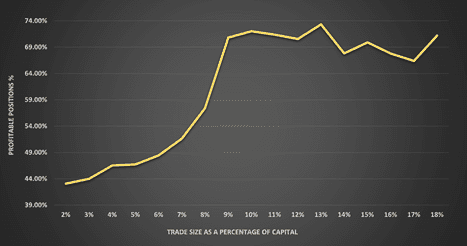
Arguably this could be the fault of the Example Investment System we tested if, for example, it wasn’t effectively exploiting the opportunities available. However, if that was the case then it’s overall performance would be poor. Instead, with a trade-size of just 4% (~ 25 positions) it back-tests at 17%+ CAGR, beating the FTSE All-Share (TR) by 300%, with all costs included, while being long only and not using leverage.
Percentages Aren’t Everything
Of course, the percentage of profitable positions is only half the story. For the full picture, we need to multiply this percentage by the average gain per winning position to arrive at the average gain across all positions. The results are shown in Chart 2, which shows a clear peak in returns (for this system) for a trade-size of 7%, or approximately 14 positions.

Risk By Another Name
A common proxy for portfolio risk is the monthly volatility of returns but what do we mean by volatility? Its mathematical formula requires an understanding of natural logarithms and standard deviations, which isn’t the intuitive understanding we’re aiming for. So lets tackle it from a different perspective by also looking at the maximum loss as a percentage of capital that was incurred on any one position. Both these metrics – volatility and maximum loss – are shown in Chart 3.

As you’d expect, the maximum loss (the green line) increases steadily as the target number of positions reduces (i.e. as the trade-size increases). This makes sense, as the larger the proportion of capital invested per position, the larger the loss, relative to capital, when things go pear shaped.
Volatility (the purple line) measures the amount by which the system’s monthly returns deviate from the average return. If the returns were exactly the same from month to month, then the volatility would be zero. As you can see, the volatility tracks the maximum loss, increasing as the trade size per position increases and for similar reasons: larger positions may result in larger losses, relative to capital, resulting in a larger deviation in the monthly returns from the norm, which is also expressed relative to capital.
The Reward to Risk Trade-Off
So both volatility and maximum capital loss reflect the risk that the system’s monthly returns may vary from the norm but how much of a risk are we talking about? Obviously, this depends on the size of the variation relative to the returns themselves, which is simply the ratio of the risk metrics to those returns. Chart 4 shows two lines: the green line is the ratio of monthly return to maximum loss, while the purple line shows the ratio of monthly returns to volatility.
As you can see, both reached their peak at a trade size of 5%, representing a target of 20 open positions at any one time. Gratifyingly, this is not dissimilar from the optimal trade size of 7% (14 positions) we determined earlier when we looked at the percentage of profitable positions

Sharpe Ratio
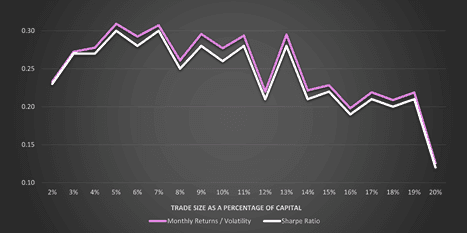
If we now plot the Sharpe Ratio and the ratio of monthly returns to volatility, as we’ve done in Chart 5 below, you’ll see that the two are essentially the same. The Sharpe Ratio calculate the excess returns relative to a risk-free rate (such as you might get from interest on gilts), so this risk-free rate is deducted from the raw monthly returns. This is why there is a small gap between the two lines (it also scales the returns slightly, but that can be ignored for the purposes of this discussion).
So there’s nothing too clever about the Sharpe Ratio. It’s simply a measure of the ‘wobble’ in the returns from month to month, relative to those returns.
Staying In The Game
Lets finish off by looking at some worst case scenarios, specifically the maximum you could lose if disaster struck and you suffered a sequence of maximal losses. For this we multiply the maximum number of consecutive losses encountered during the back-tests, for varying trade sizes, by the maximum loss as a percentage of capital, on any one position, to arrive at a worst case loss. The results are shown in Chart 6, which demonstrates that, unsurprisingly, you’d be wiped out if your portfolio was concentrated on only 5 or 6 positions.
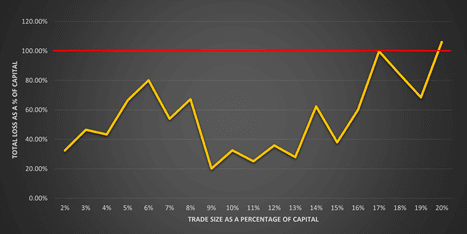
Surprisingly, a more diverse spread of 13 – 20 positions (8% – 5% trade-size) could also see you nursing chunky losses of 2/3 – 4/5 of capital. Of course, this is the worst case and, in practice, though a long sequence of losses is always possible, it’s very unlikely every single one would be worst case.
Equally surprisingly, it was the middle range of 9% – 13% trade-sizes (8 – 11 positions) that had the least alarming results.
Conclusion
From the analysis above it’s clear that trade sizing has a direct affect on the risks and rewards that might be expected when investing. We found that a trade-size of around 5% – 7%, implying a target of 14 – 20 positions, seems optimal for the system tested. However, we also saw that this range may also be associated with significant, though survivable, potential losses when there’s a general melt-down.
Perhaps those investors who advocate “around 10 positions and watch them like a hawk” have the right approach!
Thank you for reading. We hope you found this article useful.
Please Note: The information provided herein is not intended to provide and should not be construed as providing investment or financial advice and should not be relied on for making investment decisions. Nor is it intended as an endorsement or recommendation for the opinions expressed herein. Please read our Disclaimer – it is for your protection as much as ours.
Enter your email to be notified of new articles
Your email is never shared and only used for new articles
© 2025 RuleTrader Ltd. All rights reserved
