
UK Market Direction, Market Phase & Start of Rally Indicators
These are three of the five Market indicators that we publish daily on our Twitter (@RuleTraderLtd) and Facebook accounts. We do this as a service to investors and to raise awareness of RuleTrader’s abilities. In addition, we also publish a Sector Trends report in the same locations.
Market Indicators
Market Risk: Tracks the level and direction of market risk based on the VIX
Global Economy: Identifies the direction and state of the global economy
UK Market Direction: Signals whether the UK market is tending to risk or opportunity
UK Market Phase: Indicates when market rallies may have peaked and tries to warn of market corrections and bear markets
Start of Rally: Uses market breadth to signal the start of significant market rallies
Sector Trends
These reports show the annual growth rates for medium and long term price-trends in these 5 sectors, along with a list of trends that have recently broken upwards and those that may soon break downwards:
- Resources & Commodities
- Industries
- Geographies
- Exchange Rates
- Market Indices
We describe the Market Direction, Market Phase and Start of Rally indicators in more detail below. The data for each indicator is calculated by running a Trading Specification created in RuleTrader, which was used to back-test the indicator over the last 10 years. The results are shown below, with each state signalled by the indicator displayed as a series of colour-coded bars on the FTSE All-Share price charts, below. This shows when the state changes, relative to the movements in that index, so you can get an idea of how useful the indicator is, as a predictor of future market activity and price movements.
To expand any image, simply click on it. You’ll then be able to click again to magnify the image, or you can hold down your Ctrl key and use your mouse wheel to magnify the image further. To return to this article, simply use your browser’s Back button.
UK Market Direction Indicator
When things are starting to look rosy, small cap stock prices tend to rise faster than large caps and, conversely, when there are clouds on the horizon, they tend to fall faster. We exploit this dynamic to provide information on the expected direction of the UK stock market by comparing the direction and rate of change of the FTSE Small Cap and FTSE 350 indexes.
As well as comparing each market’s 40-day trend growth and direction, the indicator looks at whether the markets are moving in the same direction or diverging, as shown in the table below:
| Small Cap | Large Cap | Indicator Output |
| Rising Faster | Rising Slower | Increased Opportunity |
| Rising Slower | Rising Faster | Reduced Opportunity |
| Rising | Falling | Tending to Opportunity |
| Falling | Rising | Tending to Risk |
| Falling Slower | Falling Faster | Reduced Risk |
| Falling Faster | Falling Slower | Increased Risk |
The results of testing this indicator over the last 10 years are shown against the FTSE All-Share, in the chart below. As you can see, the indicator does a fairly sound job of signalling the direction of the market reasonably early, while there is generally still time to exploit up-trends and avoid down-trends:

UK Market Phase Indicator
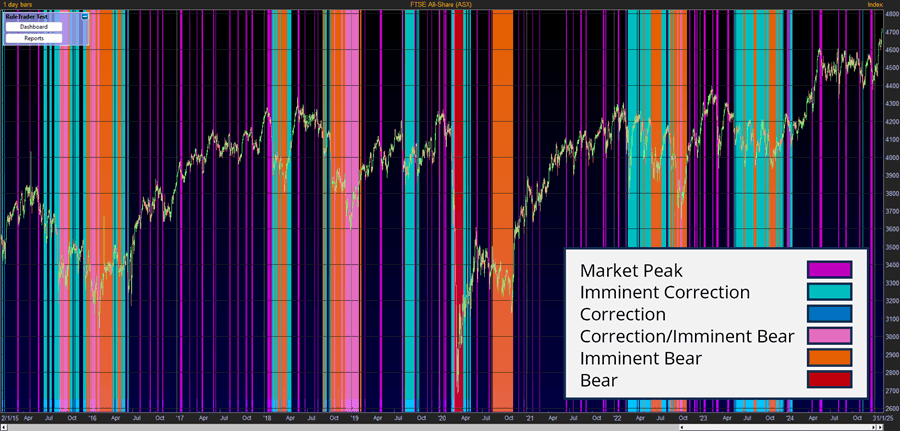
This indicator attempts to confirm when a market rally has reached its peak and to predict when a market correction or bear market may be imminent. To confirm the peak, it uses RuleTrader’s unique Top/Bottom Indicator.
To predict corrections and bears it also uses RuleTrader’s AutoTrend function to track medium and long term FTSE All-Share trends, as well as the FTSE All-Share price’s position relative to its 125 and 250-day simple moving averages (SMA). If the price is more than 2% below the short SMA and the medium channel is falling, then it flags a potential correction. Similarly, if the long trend is falling and the price is 2% or more below the long SMA, then it signals a possible bear market is ahead. Finally, if the All-Share price falls 10% (the common threshold for a correction) or 20% (the threshold for a bear) below its last peak, then it confirms the correction or bear.
While the indicator doesn’t get all market reversals, we feel it does a good job of providing confirmations of most market tops and reasonably early warning of impending down turns. You can judge the results yourself in the chart below:
Start of Rally Indicator
This indicator is designed to indicate when a significant rally is likely to have started in the FTSE All-Share. It does this by forming two lists: those shares in the index whose price went up and those whose price went down. The total volume of shares traded, as a proportion of each company’s issued shares, is calculated for each list. The up volume is then divided by the down volume to get the volume-weighted market breadth.
The indicator then calculates the 100-day simple average of that market breadth ratio and compares today’s market breadth to the average. If today’s breadth is at least 3 1/2 times larger than the average then it signals the start of a possible rally.
The thinking is that when a major rally starts there is a rush into the market by investors hoping to benefit from the up-swing. This leads to a large change (compared to the average) in the ratio of buyers to sellers, which is indicated by a much larger volume of shares whose price is being driven up by buyers, relative to those whose price is being driven down by sellers. The threshold multiple of 3 1/2 was determined by empirical testing over the last 10 years, so arguably there is a degree of curve-fitting. However, the fact that multiple held true over the entire 10 years suggest it may continue to work going forward.
The times when the indicator signalled the start of a rally are indicated by the green lines on the FTSE All-Share chart below. It’s clearly not perfect – there are a few times when it misses the start or calls the start at the top of the rally! Nevertheless, there are even more times when it catches the start of many rallies at the end of the first day of the rally or shortly thereafter. Click on the chart to view a larger one, which you can click on again to magnify. To magnify the chart further, hold down the Ctrl key on your keyboard while turning your mouse wheel.

We hope you find these indicators useful. If you have any comments on them, or ideas for other indicators you’d like to see, please contact us – we’d love to hear from you.
Meanwhile, why not check out our Market Risk and Global Economy indicators?
Please Note: The information provided herein is not intended to provide and should not be construed as providing investment or financial advice and should not be relied on for making investment decisions. Nor is it intended as an endorsement or recommendation for the opinions expressed herein. Please read our Disclaimer – it is for your protection as much as ours.
Enter your email to be notified of new articles
Your email is never shared and only used for new articles
© 2025 RuleTrader Ltd. All rights reserved
