
Market Indicators and Trend Reports
As a service to investors and to demonstrate a small part of RuleTrader’s capabilities, as well as building awareness of it’s many benefits, we’ve started posting daily Market Indicators and Sector Trend reports on our Twitter (@RuleTraderLtd) and Facebook accounts. The data for each report is calculated by running a Trading Specification created in RuleTrader.
While RuleTrader is normally used to streamline a user’s investment process by automating it, the trends and indicators below illustrate how, with fairly simple computations, RuleTrader can also be used to unlock investment insights by mining market data to find tradeable opportunities. These can then be encapsulated to provide useful signals to support a user’s investment decisions, as we show here.
Sector Trends


These reports show the current annual growth rates for medium and long term price-trends in 5 sectors. They’re automatically generated by a RuleTrader Trading Specification using its powerful AutoTrend feature. AutoTrend automatically tracks micro, short, medium and long term price-trends, which are typically over days, weeks, months and years, respectively.
As well as the top 10 up-trends by growth, if any, we also show the top new trends that have recently broken up from the high side of their previous trend. While these trends will often be up-trends (i.e. exhibiting positive growth), it isn’t always the case, as it’s entirely possible for a down-trend to break upwards from a previous down-trend, if it’s growth is less negative. Finally we list those trends that our algorithms suggest may soon break downwards from their current trend in the next few days. Note that, to save space in the report, each area is mutually exclusive, so the fastest growing trends exclude those that are shown in the New Up-Breaks (which may be growing even faster) and Imminent Down-Breaks? sections.
As you can see from the examples above, the reports cover 5 sectors, which are:
- Resources & Commodities
- Industry Sectors
- Geographic Sectors
- Exchange Rates
- Market Indices
Note that we only track the top exchange rates and market indices. If you’d like to see any others added please let us know through our contact form.
Market Indicators
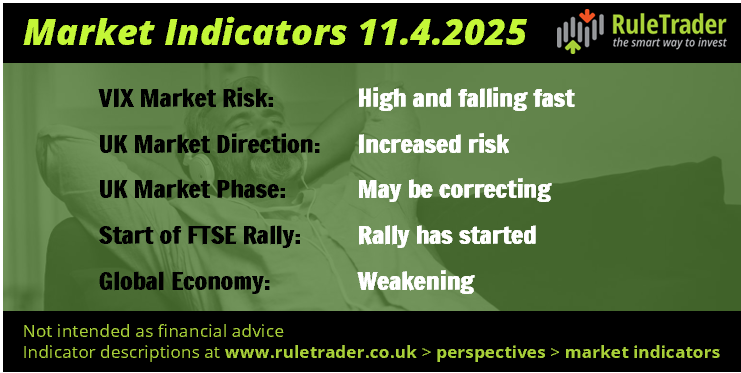
We’ve developed 5 market indicators to indicate the state of the UK market and economy, which are described below. For a more in-depth discussion of how an indicator is calculated, plus the results of a 10-year back-test of that indicator, click on the indicator name to access an article on it:
- Market Risk: Tracks the level and daily rate of change of the VIX index as a proxy for market risk and the direction that risk is moving in
- UK Market Direction: Identifies the level of opportunity / risk in the UK market by comparing the direction and rate of change of the FTSE Small Cap and FTSE 350 indexes. This takes advantage of the fact that Small Caps suffer first when risk builds and emerge first when risk recedes and opportunity beckons.
- UK Market Phase: This uses RuleTrader’s AutoTrend system to track medium and long term trends, along with RuleTrader’s unique Top/Bottom Detector. The indicator uses these with various rolling averages to indicate when rallies in the FTSE All-Share may have peaked and it also tries to identify imminent or actual market corrections and/or bear markets.
- Start of Rally: This indicator calculates volume-weighted market breadth for rising and falling shares on the FTSE All-Share to indicate when a significant rally is likely to have started. The thinking is that when a major rally starts there will be a rush to benefit, which can cause a large swing from sellers to buyers. This can be reflected in the volume of shares whose price is being driven up by purchasers, relative to those whose price is being driven down by sellers.
- Global Economic State: Uses the ratios of copper and oil to gold, and short term to long term gilt yields to signal the strength of the global economy. Copper and oil prices tend to rise relative to gold in a strong economy, while the opposite occurs as the economy weakens. Similarly, ‘yield inversion’ is a well known indicator of a possible recession starting.
We hope you find these indicators and sector trend reports useful. If you have any comments on them, or ideas for other indicators or reports you’d like to see, please contact us – we’d love to hear from you.
Please Note: The information provided herein is not intended to provide and should not be construed as providing investment or financial advice and should not be relied on for making investment decisions. Nor is it intended as an endorsement or recommendation for the opinions expressed herein. Please read our Disclaimer – it is for your protection as much as ours.
Enter your email to be notified of new articles
Your email is never shared and only used for new articles
© 2025 RuleTrader Ltd. All rights reserved
