
Market Risk and Global Economy Indicators
These are two of the five Market indicators that we publish daily on our Twitter (@RuleTraderLtd) and Facebook accounts. We do this as a service to investors and to raise awareness of RuleTrader’s abilities. These and the Sector Trends reports (that we publish in the same locations) are listed below.
Market Indicators
Market Risk: Tracks the level and direction of market risk based on the VIX
Global Economy: Identifies the direction and state of the global economy
UK Market Direction: Signals whether the UK market is tending to risk or opportunity
UK Market Phase: Indicates when market rallies may have peaked and tries to warn of market corrections and bear markets
Start of Rally: Uses market breadth to signal the start of significant market rallies
Sector Trends
These reports show the annual growth rates for medium and long term price-trends in these 5 sectors, along with a list of trends that have recently broken upwards and those that may soon break downwards:
- Resources & Commodities
- Industries
- Geographies
- Exchange Rates
- Market Indices
We describe the Market Risk and Global Economy indicators in more detail below. The data for each indicator is calculated by running a Trading Specification created in RuleTrader, which was used to back-test the indicator over the last 10 years. The results are shown below, with each state signalled by the indicator displayed as a series of colour-coded bars on the FTSE All-Share price charts, below. This shows when the state changes, relative to the movements in that index, so you can get an idea of how useful the indicator is, as a predictor of future market activity and price movements.
To expand any image, simply click on it. You’ll then be able to click again to magnify the image, or you can hold down your Ctrl key and use your mouse wheel to magnify the image further. To return to this article, simply use your browser’s Back button.
Market Risk Indicator
The Chicago Board Options Exchange Volatility index (VIX) measures S&P 500 volatility using index options. As such, it represents the market’s expectation of future market volatility in the next 30 days, with a higher value indicating higher expected volatility. As volatility may be a proxy for risk, this gives rise to the VIX’s colloquial moniker: “The Fear Index”. Typically, values under 15 are considered to be lower expected risk, while values over 25 represent higher expected risk. These thresholds are used by this indicator to classify risk:
| VIX Level | Risk Level |
| < 15 | Low |
| 15 – 20 | Medium Low |
| 20 – 25 | Medium |
| 25 – 30 | Medium High |
| > 30 | High |
Furthermore, we also track the direction and daily rate of change of the VIX index to provide an indication of how the level of risk is changing i.e. ‘Risk Rising’ or ‘Risk Falling’. If the rate of change is greater than 5% per day we say it is ‘Rising/Falling Fast’.
The results of our risk classification are shown against the FTSE All-Share, below (click to expand). As you can see, it does a reasonable job of classifying most, though not all, of the worst market corrections over the past decade:

Global Economy Indicator
This indicator reports 6 levels for the global economy: Good, Ok, Improving, Weakening, Poor and In Recession. It does this by calculating whether the trends in the ratios of the Copper price to the Gold price, and the Oil price to Gold, are moving up or down and whether the trends are moving in the same direction or diverging. The idea is that copper and oil, being inputs to the economy, will see rising prices when the economy is strengthening and falling prices when it is weakening.
Gold, which functions as a store of value, will tend to move in the opposite direction, as investors concerned about a failing economy seek to protect their wealth and so drive up its value when the economy weakens. Of course, this is only a first order indicator, as other factors obviously affect the price of these elements.
The indicator also compares the yield from 10-year gilts to 2-year gilts. Normally, longer term bonds have a higher yield because the investor is being asked to tie up their money for longer. This is especially true when the economy is strong and returns from stocks are good, as there is a higher opportunity cost for not being invested in equities.
However, if the economy is over-heating and inflation is consequently rising then central banks may raise short-term interest rates to cool things down. Ideally, they’ll engineer a soft-landing but, as history shows, in order to control inflation they may have to raise rates significantly, which in itself may lead to recession.
If investors think this might happen, they’ll buy longer term gilts to protect their wealth and to take advantage of higher interest rates now, before the central bank reduces those rates to stimulate the economy again, when/if a recession does happen.
Unfortunately, these feedback loops can become a self-fulfilling prophecy, causing both the stock market and bond yields to fall as money moves from equities to bonds, depressing stock prices and driving up bond prices (which reduces their yield), further driving the economy into the very recession everyone was trying to avoid!
At this point we can end up with higher short-term rates than long-term rates, resulting in the classic ‘yield inversion’. Since 1955 this has preceded every recession by 6 to 14 months. The exceptions were in 1966 and, if we’re lucky, the recent yield inversion in 2022 – but the jury’s still out on that one…
So that’s the theory. The Economic State indicator takes these inputs and generates its outputs, as shown in this table:
| Copper/Gold | Oil/Gold | Gilt Ratio | Economic State |
| Rising | Rising | Positive | Good |
| Falling | Rising | Positive | Ok |
| Rising | Falling | Positive | Ok |
| Rising | Rising | Negative | Improving |
| Falling | Falling | Positive | Weakening |
| Rising | Falling | Negative | Poor |
| Falling | Rising | Negative | Poor |
| Falling | Falling | Negative | Recession |
The colour-coded results of back-testing this indicator are shown below vs the FTSE All-Share, though remember the old adage: stock markets are not, in themselves, great indicators of an economy’s performance:
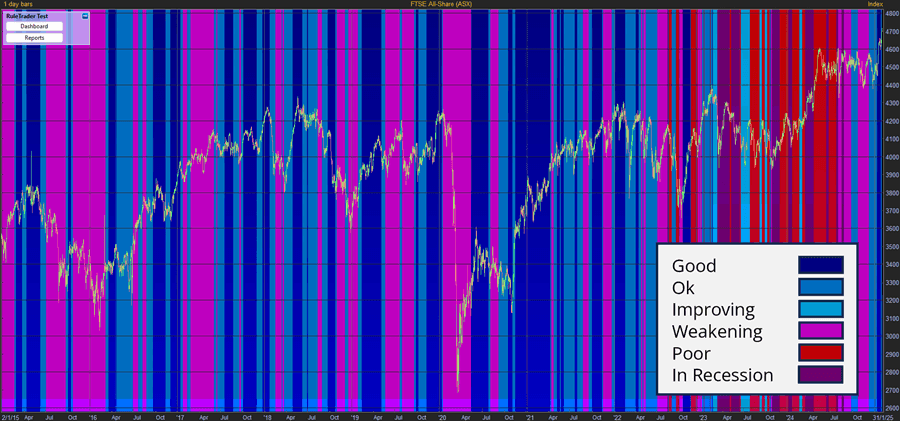
The truth of this can most recently be seen in the strong first half performance of the market in 2024, which occurred despite the fact that the UK economy was subdued (0.7% Q1 GDP flattening to 0% in Q3). At the start of the year, inflation was still high (4%) and had again risen above target by the end, business investment growth was only moderate, and consumer spending was weaker than expected. All in all, an underperforming economy, particularly in the first half, as was confirmed by this indicator.
We hope you find these indicators useful. If you have any comments on them, or ideas for other indicators you’d like to see, please contact us – we’d love to hear from you.
Meanwhile, why not check out our UK Market Direction, Market Phase & Start of Rally Indicators?
Please Note: The information provided herein is not intended to provide and should not be construed as providing investment or financial advice and should not be relied on for making investment decisions. Nor is it intended as an endorsement or recommendation for the opinions expressed herein. Please read our Disclaimer – it is for your protection as much as ours.
Enter your email to be notified of new articles
Your email is never shared and only used for new articles
© 2025 RuleTrader Ltd. All rights reserved
